
March 4, 2026
Faster Revenue Starts in Your CRM: How SMS Reactivation Turns Forgotten Leads into Sales
Your fastest revenue opportunity isn't in new leads—it's already in your CRM. Dormant contacts who previously showed interest, asked questions, or scheduled consultations represent conversations you've already started and trust you've begun building. By implementing strategic SMS reactivation campaigns, you can reconnect with these forgotten leads who don't need convincing you exist—they just need a timely reminder of why they reached out, turning your existing database into an immediate revenue engine without the cost of acquiring new prospects.
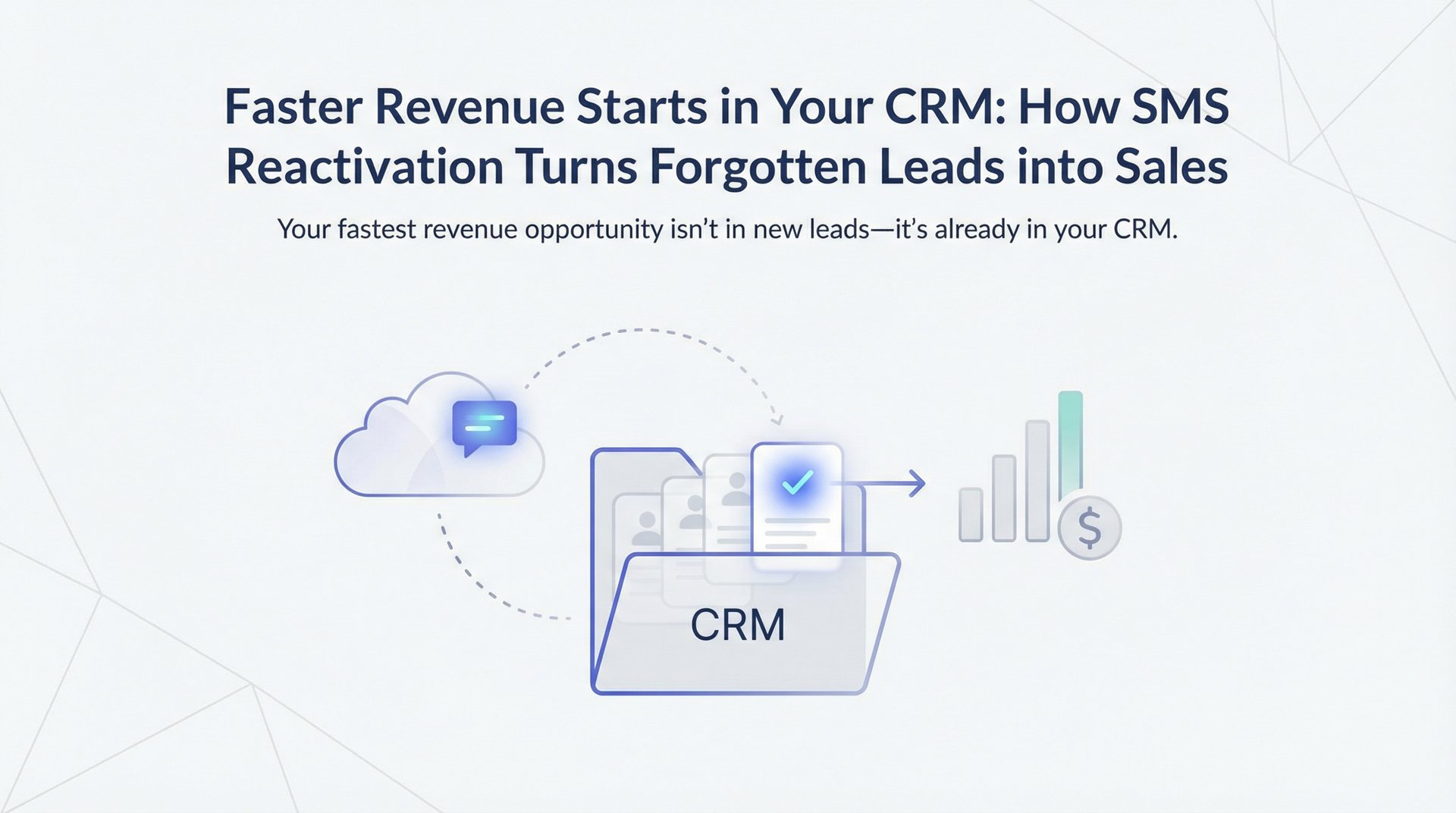

Your sales team just closed another deal from a fresh lead. Congratulations. But while you're celebrating that win, there's a harder truth sitting in your CRM: hundreds—maybe thousands—of contacts who showed interest, asked questions, maybe even scheduled consultations, and then vanished. They're not lost. They're just forgotten.
Here's the counterintuitive reality that most businesses miss: the fastest path to revenue isn't through your next marketing campaign or your latest lead generation strategy. It's already sitting in your database, waiting for someone to reach out. These dormant leads represent conversations you've already started, trust you've already begun building, and problems you've already identified. They don't need to be convinced you exist. They just need to be reminded why they reached out in the first place.
The opportunity cost of ignoring these contacts compounds every single day. While you're spending time and money acquiring strangers who've never heard of you, people who already know your name are making purchasing decisions elsewhere. The difference between faster revenue and slower revenue often comes down to one simple question: are you mining the goldmine you're already sitting on, or are you still digging for new ore?
SMS outreach changes this equation entirely. When you reconnect with dormant leads through text messaging, you're not starting from zero. You're picking up a conversation that already had momentum. The trust-building phase? Already done. The awareness stage? Already complete. You're entering at the consideration phase, which means shorter sales cycles and higher conversion rates. That's not theory. That's the fundamental economics of working smarter with what you already have.
The Hidden Economics of Database Reactivation
Let's talk about what it actually costs to acquire a new customer versus reactivating an existing lead. When you're chasing cold prospects, you're paying for awareness, education, trust-building, and then—finally—conversion. Every stage requires time, touchpoints, and marketing spend. The sales cycle stretches across weeks or months because you're building a relationship from scratch.
Now compare that to a lead already in your database. They found you once. They raised their hand. They gave you their contact information because something about your solution resonated with their problem. The awareness phase? Already paid for. The initial trust? Already established. You're not introducing yourself. You're following up.
The conversion cost difference is dramatic. Many businesses find that reactivated leads convert at a fraction of the cost of new acquisitions simply because you've eliminated multiple stages of the buyer's journey. The sales cycle compresses because you're not starting from zero—you're restarting from wherever the conversation left off.
But here's what most businesses get wrong: they assume dormant leads went cold because they weren't interested. That's rarely true. Leads go dormant for dozens of reasons that have nothing to do with your product. The timing wasn't right. Their budget was allocated elsewhere that quarter. A personal situation demanded their attention. Their decision-maker went on vacation. Life happened.
For audiologists specifically, this pattern is even more pronounced. A patient who wasn't ready for hearing aids eighteen months ago may have experienced noticeable hearing decline since then. Their spouse may have become more insistent. Their grandchildren may have started speaking, creating new motivation. The need didn't disappear—it evolved. And if you're not reaching out, they're finding solutions elsewhere. Understanding audiology lead reactivation strategies can help practices recapture these patients before competitors do.
The compounding value problem makes this worse over time. Every month a lead sits dormant, their connection to your brand weakens. The conversation you started fades from memory. The urgency they felt diminishes. Eventually, they become indistinguishable from cold prospects, requiring the same level of effort to convert. But if you reach out while the memory is still warm—even if months have passed—you're leveraging existing equity instead of building from scratch.
This is why faster revenue starts in your CRM. You've already made the investment in these relationships. The question is whether you're going to capitalize on it or let it depreciate to zero.
Why Text Messages Cut Through When Emails Disappear
Think about your own inbox right now. How many unread emails are sitting there? How many promotional messages did you scroll past this morning without opening? Now think about your text messages. When was the last time you left a text unread for more than a few minutes?
That behavioral difference is exactly why SMS outreach works so effectively for lead reactivation. Email has become background noise. The average professional receives dozens of emails daily, and most promotional messages get filtered, ignored, or deleted without a second glance. Your carefully crafted reactivation email? It's competing with fifty other messages, and the odds aren't in your favor.
Text messages operate in a completely different context. SMS open rates typically exceed 95%, with most messages read within minutes of receipt. That's not marketing hype—that's how people actually use their phones. A text notification demands immediate attention in a way email simply doesn't. It's personal, direct, and impossible to ignore.
The psychology behind this matters. When someone receives a text message, their brain processes it as interpersonal communication, not mass marketing. Even though they rationally understand businesses send automated texts, the medium itself carries an implied intimacy that email lacks. It feels like a conversation, not a campaign. That perception shift changes how recipients engage with your message.
This is particularly powerful for reactivation because you're trying to restart a relationship that went quiet. An email can feel formal, distant, easy to postpone. A text message feels immediate and personal—like someone actually remembered you and took the time to reach out. That emotional difference translates directly into response rates.
SMS also forces brevity, which is an advantage, not a limitation. You can't write a three-paragraph sales pitch in a text message. You have to get to the point immediately. That constraint creates clarity. Your message has to be valuable, relevant, and action-oriented because there's no room for fluff. Recipients appreciate that directness. Learning SMS conversion optimization techniques can help you maximize the impact of every character.
When does SMS work best for reactivation? Time-sensitive offers create natural urgency. Appointment reminders reconnect without feeling pushy. Personalized check-ins acknowledge the relationship history without demanding immediate action. The key is matching the message format to the reactivation goal. If you're offering limited-time value, text is perfect. If you're sharing a detailed case study, email might be better. But for cutting through noise and generating immediate engagement, text messaging wins.
Not Every Dormant Lead Deserves Your Attention
Here's an uncomfortable truth: not every contact in your database is worth reactivating. Some leads went dormant because they were never qualified in the first place. Others have circumstances that make conversion unlikely no matter how good your outreach. Trying to reactivate everyone wastes resources and dilutes your results. The key is knowing which leads represent genuine opportunity and which ones should stay dormant.
Recency is your first filter. A lead that engaged three months ago is fundamentally different from one that went quiet three years ago. The more recent the interaction, the warmer the connection and the higher the likelihood they'll remember your brand. Many businesses find that leads dormant for less than six months respond significantly better than older contacts. That doesn't mean you ignore older leads entirely—it means you prioritize the low-hanging fruit first.
Original interest level tells you what kind of conversation you're restarting. Did this lead download a whitepaper and disappear, or did they schedule a consultation and ghost you afterward? The depth of their initial engagement indicates how serious they were. Someone who took multiple steps toward conversion but didn't complete the journey is a very different prospect than someone who casually browsed your website once.
Engagement history reveals patterns. Did this lead respond to previous follow-ups? Did they open emails, click links, or interact with your content? A lead with zero engagement across multiple touchpoints is sending a clear signal: they're not interested. Continuing to reach out becomes spam at that point. But a lead who engaged initially and then went silent might just need better timing or a different approach.
For audiologists, there are specific green lights worth watching for. A lead who completed a hearing assessment but didn't purchase? High priority—they've acknowledged the problem. Someone who asked about pricing but didn't schedule? Worth reactivating—budget or timing might have changed. A contact who attended an educational event but didn't follow up? Good candidate—they're researching solutions. These behaviors indicate genuine interest that circumstances prevented from converting.
Red flags matter too. A lead who explicitly opted out of communications should stay dormant—period. Someone who disputed a charge or left negative feedback? Probably not your reactivation target. Contacts who work for competitors or were clearly researching for academic purposes rather than purchasing? Skip them. The goal is identifying leads who wanted to buy but didn't, not convincing people who were never real prospects.
This is where AI lead scoring becomes invaluable. Manual segmentation works for small databases, but when you're dealing with thousands of contacts, you need intelligent prioritization. AI systems can analyze dozens of variables simultaneously—recency, engagement depth, interaction patterns, demographic fit, behavioral signals—and assign probability scores that predict which leads are most likely to convert quickly. That means your reactivation efforts focus on the highest-value opportunities instead of blindly messaging everyone.
The practical outcome is simple: you want to identify leads who showed clear buying intent, engaged meaningfully with your brand, and went dormant for circumstantial reasons rather than fundamental disinterest. Those are your faster revenue opportunities. Everything else is noise.
The Art of the Reactivation Message
You've identified your high-value dormant leads. Now comes the critical part: what do you actually say? The wrong message feels pushy, tone-deaf, or generic. The right message acknowledges the gap, provides immediate value, and creates a clear path forward. Let's break down what actually works.
Personalization isn't optional—it's the foundation. A generic "Hey, haven't heard from you in a while" message signals that you're blasting your database, not reaching out individually. But a message that references their specific situation changes everything. For an audiologist, that might look like: "Hi Sarah, you mentioned concerns about hearing your grandkids clearly when we spoke last fall. Wanted to check in—how's that been going?" That's not a sales pitch. That's a genuine check-in that demonstrates you remember the conversation.
The value component has to be immediate and relevant. You're interrupting someone's day, so you need to justify the interruption. This could be new information that addresses their original concern, a limited-time offer that creates urgency, or a simple resource that helps them make progress. The key is leading with what benefits them, not what benefits you. "We've just released a new model that addresses the background noise issues you were worried about" is valuable. "We'd love to reconnect" is not.
Your call-to-action must be specific and low-friction. "Let me know if you're interested" is vague and easy to ignore. "Reply YES if you'd like me to send over the details" is concrete and requires minimal effort. "Would Tuesday or Thursday work better for a quick call?" provides options and assumes forward movement. The easier you make it to respond, the more responses you'll get.
Timing and frequency require restraint. One message might get ignored because of bad timing. Three messages over two weeks shows persistence. Seven messages over a month becomes harassment. Many businesses find that a three-touch sequence works well: an initial reactivation message, a follow-up a week later providing additional value, and a final "last chance" message another week after that. If there's no response after three attempts, it's time to move on.
The message framework that consistently works acknowledges the gap without apologizing for it. Something like: "It's been a few months since we last connected, and I wanted to reach out because [specific reason related to their situation]. [New value or information]. [Clear, easy call-to-action]." This structure respects the relationship history, provides fresh value, and makes the next step obvious.
For audiologists specifically, effective reactivation messages often tie to life events or seasonal triggers. "Hi James, with the holidays coming up, I know family gatherings can be challenging if hearing isn't where you want it. Want to chat about options before Thanksgiving?" That's timely, relevant, and acknowledges a real pain point without being pushy. It's not "Buy hearing aids now"—it's "I remember your situation, and there's a reason this might matter to you right now."
What doesn't work? Pretending the gap didn't happen. Launching into a hard sell. Using pressure tactics. Sending walls of text. Being vague about what you want. All of these approaches trigger immediate deletion. The goal is restarting a conversation, not closing a sale in the first message. If you can get a response—any response—you've successfully reactivated the lead. Everything else follows from there.
From Manual Chaos to Revenue on Autopilot
Let's be honest about what happens with manual follow-up: it doesn't happen consistently. Your sales team has good intentions. They know they should reach out to old leads. But when they're juggling active opportunities, incoming inquiries, and daily fires, those dormant contacts never make it to the top of the priority list. It's not negligence—it's human nature. Hot leads get attention. Cold leads get forgotten. Again.
This is why manual reactivation fails at scale. Even if your team commits to reaching out to ten dormant leads per day, that's fifty per week, maybe two hundred per month. If you have thousands of dormant contacts, you're looking at months or years to work through your database. Meanwhile, new leads keep going dormant, and the backlog grows faster than you can address it. You're bailing water with a teaspoon.
Consistency is the hidden variable that makes reactivation work. A single outreach attempt has limited impact. But a systematic approach that ensures every qualified dormant lead receives multiple touchpoints at optimal intervals? That generates results. The problem is that humans can't maintain that level of consistency. We get busy, we forget, we deprioritize. Automation doesn't.
This is where customer winback automation changes the equation entirely. Instead of manually deciding who to contact and when, you establish the criteria once, and the system handles execution. Every dormant lead that meets your qualification standards automatically enters a reactivation sequence. Messages go out at optimal times. Follow-ups happen on schedule. No one slips through the cracks because someone got busy or went on vacation.
The beauty of automation is that it works while you sleep. Your database reactivation campaign runs continuously, identifying newly dormant leads, prioritizing high-value contacts, and executing personalized outreach sequences without requiring daily management. You're essentially creating a revenue engine that operates independently of your team's bandwidth constraints.
Integration with your existing CRM workflow is critical. The reactivation system needs to know which leads are dormant, access their interaction history for personalization, and update their status when they re-engage. If someone responds to a reactivation message, that should trigger an immediate alert to your sales team and update their CRM record. The automation handles the outreach; your team handles the conversations that result.
For hearing aid practices, this might mean automatically identifying patients who completed assessments but didn't purchase, waiting an appropriate interval, then initiating a personalized SMS sales sequence that references their specific concerns. If they respond, the system notifies the appropriate audiologist and schedules a follow-up consultation. If they don't respond after the sequence completes, they're marked for future reactivation attempts. The entire process runs without manual intervention.
The scalability is what makes this powerful. Whether you have five hundred dormant leads or five thousand, the system handles them all with the same consistency and attention to timing. Your team's capacity is no longer the limiting factor. You're not choosing between reactivation and other priorities—you're doing both simultaneously.
Your Week-One Reactivation Blueprint
Theory is useful. Action is better. Here's exactly how to launch a database reactivation campaign in seven days, turning dormant leads into active conversations before next week ends. This isn't a months-long implementation—it's a focused sprint that generates immediate results.
Day 1: Audit your CRM and segment your dormant leads. Export contacts who haven't engaged in the last 90-180 days but showed meaningful interest initially. Remove anyone who opted out or clearly isn't qualified. Create three priority tiers: high-value leads who came close to converting, medium-value leads who showed solid interest, and lower-priority leads who engaged minimally. Start with your high-value segment—this is your fastest path to revenue.
Day 2: Craft your reactivation message templates. Write three variations: the initial outreach, the value-add follow-up, and the final check-in. Personalize each template with merge fields that reference specific details from their CRM record. Test your messages by sending them to yourself and colleagues—do they feel personal or generic? Would you respond? Refine until the tone feels right. Remember: you're restarting a conversation, not launching a sales pitch.
Day 3: Set up your automation workflow or prepare your manual outreach schedule if you're starting without automation. If you're using a reactivation platform, configure your sequences with appropriate timing intervals—typically 5-7 days between messages. If you're going manual, create a spreadsheet that tracks who gets contacted when and what their response status is. The goal is ensuring consistent follow-through regardless of approach.
Day 4: Launch your first wave of outreach to your highest-priority segment. Start with a manageable number—maybe 50-100 contacts—so you can handle responses without getting overwhelmed. Send your initial reactivation messages and monitor what happens. This is your learning phase. Which messages generate responses? What questions do people ask? What objections surface? Take notes.
Day 5: Respond to everyone who engaged with your Day 4 outreach. Speed matters here—if someone replies within an hour and you don't respond until the next day, you've lost momentum. Have your team ready to handle inbound responses immediately. Book consultations, answer questions, and move conversations forward. Simultaneously, send your second wave of outreach to another segment of your database.
Day 6: Analyze your early results and adjust your approach. What's your response rate? Are certain message variations performing better than others? Are specific lead segments more responsive? Use this data to refine your templates and targeting. Send follow-up messages to anyone from Day 4 who didn't respond. Continue processing responses from Day 5's outreach.
Day 7: Scale what's working. If certain message types or lead segments are generating strong responses, double down on those. If something isn't working, pause and revise. Send your final follow-up messages to the initial batch from Day 4. Calculate your week-one metrics: total leads contacted, response rate, conversations started, appointments booked, and revenue generated or in pipeline. This becomes your baseline for improvement.
The metrics that matter most are response rate (what percentage of contacted leads engage), appointment booking rate (how many responses convert to scheduled conversations), and attributed revenue (sales that result from reactivation outreach). Many businesses find that even modest response rates—5-10%—generate significant revenue when applied to large dormant databases. A 7% response rate on 1,000 dormant leads means 70 conversations you wouldn't have had otherwise.
Scaling what works means identifying your highest-performing combinations of message type, lead segment, and timing, then systematically applying those patterns to your entire database. If reactivating leads dormant for 90-120 days generates better results than older contacts, prioritize that window. If messages referencing specific pain points outperform generic check-ins, use more specificity. Let the data guide your iteration.
Stop Leaving Money on the Table
Faster revenue isn't a mystery. It's not about finding some secret marketing channel or perfecting your sales pitch. It's about recognizing that the most valuable leads you'll ever have are the ones already sitting in your CRM—people who raised their hands, expressed interest, and then slipped away before converting. They're not lost opportunities. They're dormant opportunities waiting for someone to reach out.
The businesses that win aren't the ones working hardest on acquisition. They're the ones working smartest with what they already have. They understand that reactivating an existing lead costs a fraction of acquiring a new one and converts faster because the relationship foundation already exists. They leverage SMS outreach because text messages cut through noise in ways email never will. They automate the process because consistency at scale is impossible manually.
Your database represents conversations you've already started, trust you've already built, and problems you've already identified. Every day those contacts sit dormant, you're leaving money on the table. Not because they're not interested—but because no one's reaching out to restart the conversation. Meanwhile, they're making purchasing decisions elsewhere, choosing competitors who stayed in touch.
The seven-day action plan outlined above isn't theoretical. It's a practical blueprint that businesses are using right now to turn dormant databases into active revenue streams. The question isn't whether this works—it's whether you're going to implement it before your competitors do. Because once they start reactivating their databases effectively, they're not just winning new business. They're winning business that could have been yours.
For audiologists specifically, this matters even more. Your dormant leads aren't just potential customers—they're people whose hearing loss has likely progressed since you last spoke. Their need hasn't disappeared. It's intensified. And if you're not the one reaching out to help them, someone else will be. The patients you could have helped are finding solutions elsewhere, not because your services aren't valuable, but because they forgot you exist. Implementing automated follow-up for audiologists ensures no patient falls through the cracks.
The path forward is clear. Audit your database. Identify your high-value dormant leads. Craft personalized reactivation messages that acknowledge the relationship and provide immediate value. Launch systematic outreach that ensures no one slips through the cracks twice. Track what works and scale it. This isn't about working harder—it's about working smarter with assets you already own.
Stop Leaving Money on the Table – Revive Your Leads in 7 Days or Less. Your dormant database represents revenue that's already within reach. The only question is whether you're going to claim it or let it continue sitting there, depreciating in value every single day. The fastest path to revenue doesn't require new leads, new campaigns, or new strategies. It requires reaching out to the people who already know you and reminding them why they reached out in the first place. That conversation starts now.
Want More Appointments Without Buying More Leads?
Most businesses are sitting on hundreds or thousands of past inquiries that never converted. We built a simple SMS reactivation system that turns those forgotten leads into real conversations and booked appointments.
See How It Works