
March 2, 2026
SMS vs Email in Lead Reactivation: Which Performs Better?
SMS dramatically outperforms email in lead reactivation, with text messages appearing directly on lock screens while emails get buried in crowded inboxes. This analysis compares SMS vs email in lead reactivation for hearing care professionals, showing how AI-powered SMS personalization transforms dormant CRM contacts into revenue by reaching prospects where they actually pay attention.
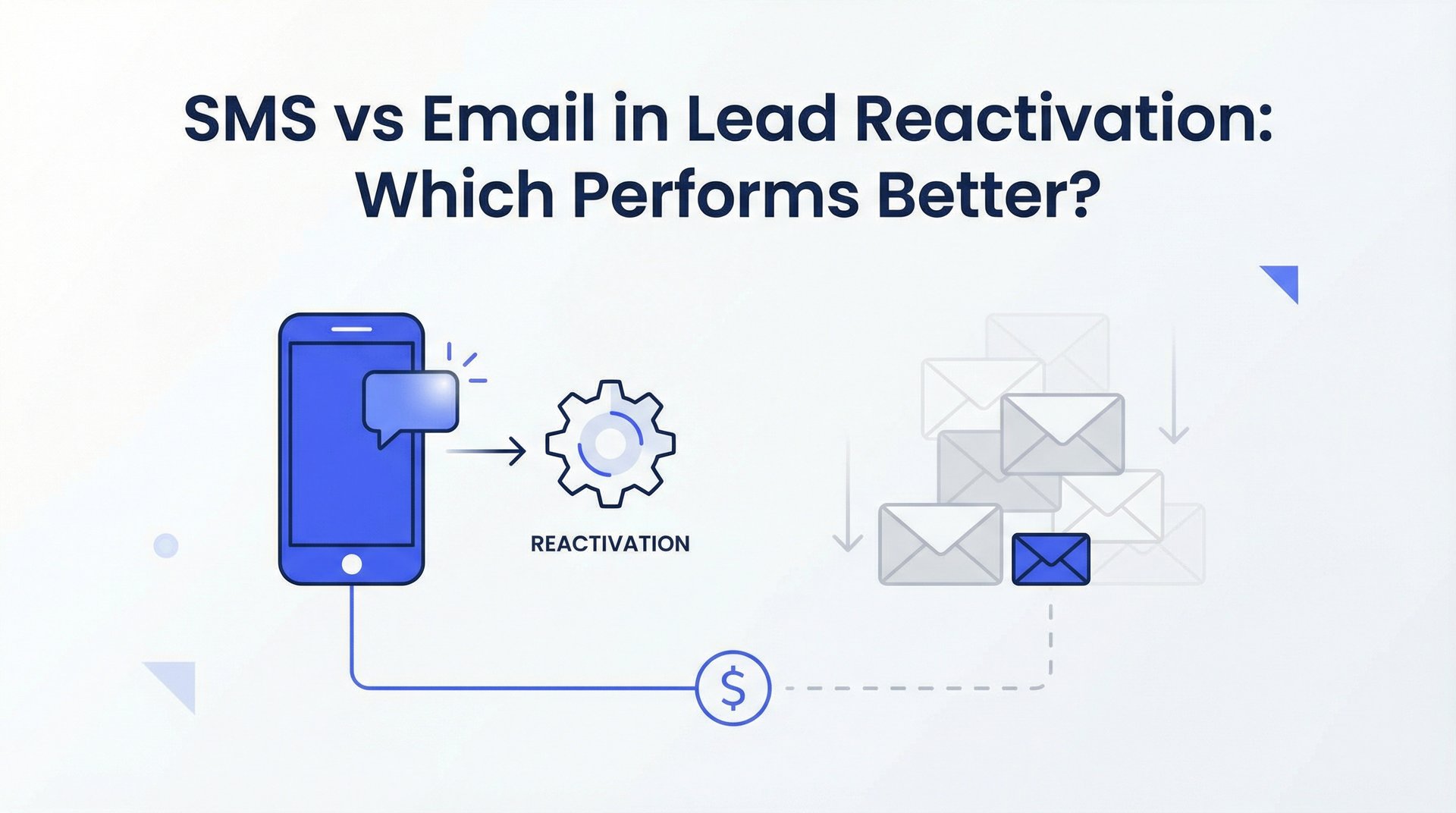

Your CRM holds thousands of dormant leads—prospects who showed interest but never converted. The question isn't whether to reactivate them, but how. Email has been the default channel for decades, but SMS is rapidly proving itself as the superior choice for lead reactivation. This comparison examines both channels head-to-head, revealing why SMS consistently outperforms email when reconnecting with cold leads—and how combining the right channel with AI-powered personalization transforms forgotten contacts into revenue. For audiologists and hearing care professionals sitting on databases of unconverted patients, understanding this distinction could mean the difference between leaving money on the table and unlocking a hidden revenue stream.
The shift isn't just about technology. It's about meeting your leads where they actually pay attention. While your carefully crafted emails languish in crowded inboxes, text messages sit on the lock screens of the very people you're trying to reach.
1. Open Rate Advantage: Getting Your Message Seen
The Challenge It Solves
The most beautifully crafted reactivation message means nothing if it never gets opened. Email inboxes have become battlegrounds where your message competes with hundreds of others, promotional filters, and years of accumulated email fatigue. Your dormant leads aren't ignoring you because they're not interested—they simply never see your outreach in the first place.
For audiology practices reaching out to patients who inquired about hearing aids months ago, this visibility gap is particularly costly. These aren't cold prospects; they're people who already expressed interest in solving a real problem. The challenge is cutting through the noise to remind them you exist.
The Strategy Explained
SMS messages are typically opened within minutes of receipt, while emails often sit unopened for hours or days. Industry consensus indicates SMS open rates generally exceed 90%, while email marketing averages 20-25% open rates. This isn't a marginal difference—it's a fundamental shift in whether your reactivation efforts even reach your audience.
Think of it like this: email is leaving a voicemail in a full mailbox, while SMS is tapping someone on the shoulder. The immediacy of text messages creates a psychological urgency that email simply cannot match. When your message appears on a lock screen alongside texts from friends and family, it carries an implicit importance that promotional emails never achieve.
This visibility advantage compounds over time. While email open rates decline with each subsequent message in a campaign, SMS maintains consistently high open rates throughout multi-touch sequences. Your seventh text gets nearly the same attention as your first—a pattern that's impossible to replicate with email.
Implementation Steps
1. Segment your dormant lead database by how long they've been inactive—recent dropoffs respond differently than year-old contacts, and your messaging should reflect that timeline.
2. Craft concise opening messages that immediately identify your business and reference the lead's previous interest without requiring them to dig through their memory.
3. Schedule messages during high-engagement windows—typically mid-morning or early evening when people actively check their phones but aren't overwhelmed with work communications.
Pro Tips
Always include your business name in the first message to establish context immediately. For audiology practices, reference the specific service they inquired about: "Hi [Name], this is [Practice Name]. You asked about hearing solutions a few months back." This instant recognition prevents your message from feeling like spam and sets the stage for productive re-engagement.
2. Response Rate Superiority: Driving Actual Engagement
The Challenge It Solves
Getting your message opened is only the first hurdle. The real goal of lead reactivation is sparking a conversation that moves dormant contacts back into your sales pipeline. Email campaigns often generate opens without clicks, clicks without replies, and replies that arrive days too late to maintain momentum. You need a channel that doesn't just reach people—it prompts them to respond.
The Strategy Explained
SMS response rates consistently outperform email click-through rates across most industries. The conversational nature of texting creates a lower barrier to engagement than email's formal structure. When someone receives a text message, replying feels natural—like continuing a conversation rather than completing a form or navigating to a website.
This psychological difference is crucial for reactivation campaigns. Your dormant leads already demonstrated hesitation by not converting initially. The easier you make it for them to re-engage, the more likely they are to take that step. A simple text reply requires less commitment than clicking through an email, filling out a form, or picking up the phone.
The speed of SMS responses also keeps conversations alive. Email exchanges can drag out over days, losing momentum with each delayed reply. Text conversations happen in real-time or near-real-time, allowing you to address objections, answer questions, and guide leads toward conversion while their interest is active.
Implementation Steps
1. Design your SMS sequences with clear, simple response prompts—ask yes/no questions or offer multiple-choice options that can be answered with a single word or number.
2. Set up automated response handling for common replies so leads receive immediate acknowledgment even outside business hours, maintaining conversation momentum.
3. Train your team to respond to SMS inquiries within minutes during business hours—the expectation of quick text replies means delayed responses can kill re-engagement opportunities.
Pro Tips
Structure your initial reactivation text to invite a simple reply: "Would you still like information about improving your hearing? Reply YES and I'll send details." This low-friction response mechanism dramatically increases engagement compared to asking leads to click a link or call a number. For audiology practices, this approach helps you quickly identify which dormant leads are worth pursuing with personalized follow-up.
3. AI-Powered Personalization: Treating Leads as Individuals
The Challenge It Solves
Generic reactivation messages fail because they ignore the specific reasons each lead went dormant. Some prospects weren't ready to buy. Others had budget concerns. Some simply got distracted by life events. Treating your entire dormant database with identical messaging wastes the valuable context already sitting in your CRM—and makes your outreach feel like spam rather than genuine assistance.
The Strategy Explained
Hyper-personalized SMS sequences using CRM data transform reactivation from broadcasting to conversation. AI-powered systems analyze each lead's interaction history, inquiry details, timeline, and behavior patterns to craft messages that speak directly to their specific situation. This isn't mail-merge personalization that drops a name into a template—it's intelligent messaging that adapts its approach based on what you already know about each contact.
Picture this: A patient inquired about hearing aids eight months ago but never scheduled a consultation. AI-driven personalization recognizes this timeline and crafts a message acknowledging the time gap while offering a gentle re-entry point: "Hi [Name], checking in since your hearing evaluation inquiry last spring. Technology has improved significantly—would a quick update be helpful?" This approach feels helpful rather than pushy because it's grounded in the lead's actual history.
The power multiplies when personalization extends beyond the first message. Subsequent texts adapt based on responses, creating branching conversation paths that feel natural rather than scripted. If a lead mentions budget concerns, the sequence shifts to financing options. If they express continued interest but cite time constraints, it pivots to flexible scheduling. This dynamic adaptation is what separates effective reactivation from annoying spam.
Implementation Steps
1. Audit your CRM data to identify the key variables that should drive personalization—inquiry type, time since last contact, previous objections, service interest level, and any notes from past interactions.
2. Map out conversation branches based on common lead scenarios in your database—the "not ready yet" leads need different messaging than "price shopper" leads or "got distracted" leads.
3. Implement AI-powered SMS automation that can dynamically select message variations based on lead characteristics, ensuring each contact receives contextually relevant outreach without manual customization.
Pro Tips
Reference specific details from the lead's original inquiry to prove your message isn't generic: "You mentioned difficulty hearing in restaurants" or "You were interested in our rechargeable hearing aid options." This specificity immediately differentiates your reactivation attempt from mass marketing and reminds leads why they reached out in the first place. The combination of SMS immediacy with AI-driven personalization creates reactivation campaigns that feel like helpful check-ins rather than sales pitches.
4. Channel Trust Factor: Bypassing Digital Gatekeepers
The Challenge It Solves
Your reactivation emails aren't just competing with other messages—they're fighting sophisticated spam filters, promotional tab segregation, and years of conditioning that has trained your leads to ignore marketing emails entirely. Even when your messages technically reach the inbox, they arrive pre-labeled as "promotional" or buried under dozens of similar messages. You need a channel that reaches people directly without passing through digital gatekeepers.
The Strategy Explained
SMS bypasses the filtering mechanisms that plague email marketing. Text messages arrive directly on the main screen of someone's phone, in the same interface they use to communicate with friends, family, and colleagues. There's no spam folder for SMS, no promotional tab, and no algorithm deciding whether your message deserves visibility.
This direct access creates an inherent trust advantage. When your text appears alongside personal communications, it carries an implicit credibility that promotional emails lack. People have been trained to distrust email marketing—to assume promotional messages are either irrelevant or deceptive. SMS hasn't accumulated that same baggage, particularly for local service businesses like audiology practices where text communication feels appropriate and professional.
The personal nature of SMS also creates accountability that discourages abuse. Businesses know that sending irrelevant or excessive text messages will prompt immediate unsubscribes and damage their reputation. This self-regulation means the SMS channel remains relatively clean, which benefits legitimate reactivation efforts. Your message isn't just one of hundreds—it's one of a handful of business communications your lead receives via text each week.
Implementation Steps
1. Obtain proper consent for SMS communications during the initial lead capture process—explicit opt-in builds trust and ensures compliance while setting expectations for future text outreach.
2. Maintain a professional but conversational tone in your SMS messages that matches how people actually communicate via text, avoiding the overly formal language that makes email feel corporate.
3. Respect the intimacy of the SMS channel by limiting message frequency and ensuring every text provides genuine value—you're entering someone's personal communication space, so earn that privilege.
Pro Tips
Always provide a clear, simple opt-out mechanism in your SMS campaigns: "Reply STOP to opt out." This transparency builds trust and demonstrates respect for the recipient's preferences. For audiology practices, this approach is particularly important because you're often dealing with older adults who may be less familiar with text marketing but highly responsive once they understand it's a legitimate communication from a healthcare provider they previously contacted.
5. True Cost-Per-Conversion: ROI Beyond Surface Metrics
The Challenge It Solves
SMS costs more per message than email—that's an undeniable fact that causes many businesses to default to email for reactivation campaigns. But this surface-level cost comparison misses the bigger picture. When you're reactivating dormant leads, the metric that matters isn't cost-per-message; it's cost-per-conversion. Sending thousands of cheap emails that nobody opens or responds to is far more expensive than sending hundreds of text messages that actually generate sales.
The Strategy Explained
Higher SMS costs are dramatically offset by superior conversion rates and ROI. Let's break down the real economics: If you send 1,000 reactivation emails at virtually no cost but only convert two leads, your cost-per-conversion includes all the opportunity cost of the 998 leads you failed to reactivate. Meanwhile, sending 1,000 SMS messages at a few cents each but converting 20 leads represents a fraction of the actual cost-per-acquisition.
This calculation becomes even more favorable when you factor in the lifetime value of reactivated customers. For audiology practices, a single converted patient can represent thousands of dollars in hearing aid sales, follow-up appointments, and referrals. When one SMS-driven conversion pays for hundreds of text messages, the channel cost becomes irrelevant compared to the revenue impact.
The efficiency gains extend beyond direct conversions. SMS campaigns require less time to create and manage than elaborate email sequences with design elements, A/B testing, and complex automation. Your team spends less time crafting campaigns and more time responding to the engagement those campaigns generate. This operational efficiency compounds the ROI advantage.
Implementation Steps
1. Calculate your current email reactivation conversion rate and cost-per-acquisition to establish a baseline for comparison—most businesses discover their "free" email campaigns are actually quite expensive when measured by results.
2. Start with a pilot SMS reactivation campaign targeting your most recently dormant leads, tracking not just response rates but actual conversions and revenue generated to build a true ROI picture.
3. Analyze the lifetime value of reactivated customers versus the channel cost—this long-term perspective reveals that SMS's higher upfront cost is negligible compared to the revenue it unlocks from your existing database.
Pro Tips
Focus your SMS budget on your highest-value dormant leads first—those who inquired about premium services, showed strong initial interest, or have the highest potential lifetime value. This targeted approach maximizes ROI while you refine your messaging and strategy. For audiology practices, this might mean prioritizing leads who inquired about advanced hearing aid technology over those who only requested general information, ensuring your SMS investment targets the most convertible prospects in your database.
6. Industry-Specific Application: SMS for Appointment-Based Services
The Challenge It Solves
Appointment-based service businesses face a unique reactivation challenge: converting interest into scheduled action. It's not enough for a dormant lead to think "that sounds good" when they see your message—they need to actually book an appointment. Email's multi-step process (open message, click link, navigate website, fill out form) creates multiple abandonment points. You need a channel that collapses this friction and makes scheduling feel effortless.
The Strategy Explained
SMS is particularly effective for appointment-based services like audiology practices because it mirrors how people already schedule personal commitments. Think about how you confirm plans with friends or schedule service appointments—increasingly, it happens via text. This behavioral pattern makes SMS feel like the natural channel for booking professional services, especially in healthcare contexts where the personal touch matters.
The conversational nature of SMS allows for real-time scheduling coordination that email cannot match. When a dormant lead responds with interest, you can immediately offer specific appointment times, answer questions about the process, and confirm booking—all within a single text thread that feels like a helpful conversation rather than a transactional process. This immediacy is crucial for capturing interest before it fades.
For audiology practices specifically, SMS addresses common patient concerns about hearing evaluations. Many dormant leads hesitated because they felt anxious about the appointment process or uncertain about time commitment. Text conversations allow staff to provide reassurance, explain what to expect, and emphasize the quick, painless nature of hearing assessments. This personal touch through SMS converts hesitant leads who would ignore even the most persuasive email.
Implementation Steps
1. Create SMS templates that move from reactivation to scheduling in two to three messages—keep the path from "Hi, remember us?" to "You're booked for Tuesday at 2pm" as short as possible.
2. Integrate your SMS platform with your scheduling system so staff can check availability and confirm appointments without leaving the text conversation, eliminating delays that cause leads to reconsider.
3. Train your team to use SMS for appointment reminders and follow-up with reactivated leads, creating a consistent text-based communication thread that keeps patients engaged through their first appointment and beyond.
Pro Tips
Offer specific appointment options in your reactivation texts rather than asking leads to choose from your full calendar: "I have openings Tuesday at 10am or Thursday at 2pm—which works better for you?" This constrained choice makes scheduling feel easier and faster than open-ended availability questions. For audiology practices, mention that evaluations are quick and painless in your initial text to address the unstated anxiety many patients feel about hearing assessments, removing a barrier before it becomes an objection.
7. Implementation Framework: Deploying Automated SMS Reactivation
The Challenge It Solves
Understanding that SMS outperforms email is one thing—actually implementing an effective SMS reactivation system is another. Many businesses hesitate because they imagine the manual effort of texting hundreds or thousands of dormant leads individually. Without proper automation, SMS reactivation would be prohibitively time-consuming. You need a framework that delivers SMS's superior performance without requiring proportional manual effort.
The Strategy Explained
Automated SMS reactivation campaigns combine the channel's inherent advantages with intelligent automation that works around the clock. The system identifies dormant leads in your CRM, segments them based on relevant criteria, and initiates personalized text sequences without manual intervention. When leads respond, the automation handles common questions and routes qualified responses to your team for human follow-up.
This isn't about replacing human interaction—it's about scaling it intelligently. Automation handles the initial outreach and qualification, ensuring every dormant lead receives timely, personalized contact. Your team focuses their energy on the leads who respond positively, having productive conversations with prospects who've already been warmed up by the automated sequence. This division of labor maximizes both efficiency and effectiveness.
The key is implementing automation that feels personal rather than robotic. Advanced systems use AI to vary message timing, adapt language based on lead characteristics, and create conversation flows that respond naturally to different replies. When done correctly, recipients can't tell they're interacting with automation until a human team member seamlessly takes over the conversation.
Implementation Steps
1. Define your dormancy criteria—decide when a lead officially becomes "dormant" in your system (30 days without engagement, 60 days, 90 days) and set up automated triggers that initiate SMS sequences when leads cross that threshold.
2. Build a multi-touch SMS sequence with 3-5 messages spaced over 10-14 days, each with a clear purpose—the first message reintroduces your business, the second provides value or addresses common objections, the third creates urgency or offers an incentive, and subsequent messages serve as final touchpoints.
3. Create response handling rules that automatically categorize replies (interested, not interested, questions, scheduling requests) and route them appropriately—interested leads go to your sales team immediately, questions trigger relevant automated responses, and uninterested contacts are removed from the sequence.
4. Integrate your SMS platform with your CRM so all conversations are logged, lead statuses update automatically, and your team has full context when they take over conversations from the automated system.
5. Monitor performance metrics weekly—track not just open and response rates but actual conversions and revenue generated, using this data to refine your messaging, timing, and segmentation strategies continuously.
Pro Tips
Start your automated sequences during mid-week, mid-morning hours when response rates are typically highest, giving your campaign momentum from the first message. For audiology practices, consider seasonal timing—many people think about hearing health around the holidays when family gatherings highlight communication difficulties, making late fall an ideal time to reactivate dormant patient leads. Build in "human handoff" indicators in your automation so team members know exactly when to jump into conversations, ensuring smooth transitions that maintain the personal feel your SMS campaign established.
Putting It All Together
The data consistently points to SMS as the superior channel for lead reactivation. Higher open rates, faster response times, and better engagement make text messaging the clear winner when reconnecting with dormant leads. But channel selection is only half the equation—the real transformation happens when SMS is paired with AI-driven personalization that treats each lead as an individual, not a number.
For businesses sitting on untapped CRM databases, especially audiologists with unconverted patient leads, the opportunity cost of relying on email alone is significant. Every month you delay implementing SMS reactivation is another month of revenue left on the table. These aren't cold prospects you need to find and qualify—they're people who already raised their hands and expressed interest in your services. They're sitting in your database right now, waiting for the right message through the right channel to bring them back.
The path forward combines the right channel (SMS) with intelligent automation that works around the clock, turning forgotten leads into new revenue without manual outreach. Start by segmenting your dormant database, identifying your highest-value prospects, and implementing a pilot SMS reactivation campaign. Track real results—conversions and revenue, not just open rates—and scale what works.
Your dormant leads represent one of the most valuable untapped assets in your business. They've already demonstrated interest. They're already in your system. The only question is whether you'll reach them effectively. SMS isn't just marginally better than email for this purpose—it's fundamentally more effective at every stage of the reactivation process.
Stop leaving money on the table. Revive your leads in 7 days or less with automated SMS reactivation that combines the superior performance of text messaging with AI-powered personalization. Your database holds more revenue than you realize—it's time to unlock it.
Want More Appointments Without Buying More Leads?
Most businesses are sitting on hundreds or thousands of past inquiries that never converted. We built a simple SMS reactivation system that turns those forgotten leads into real conversations and booked appointments.
See How It Works