
February 15, 2026
Sales Funnel Reactivation: How to Turn Forgotten Leads Into Revenue
Your CRM contains thousands of dollars in untapped revenue from leads who already showed interest but went silent. Sales funnel reactivation is the systematic process of re-engaging these dormant prospects—people who visited your site, downloaded content, or requested pricing—turning forgotten leads into customers without the high cost of acquiring entirely new ones.
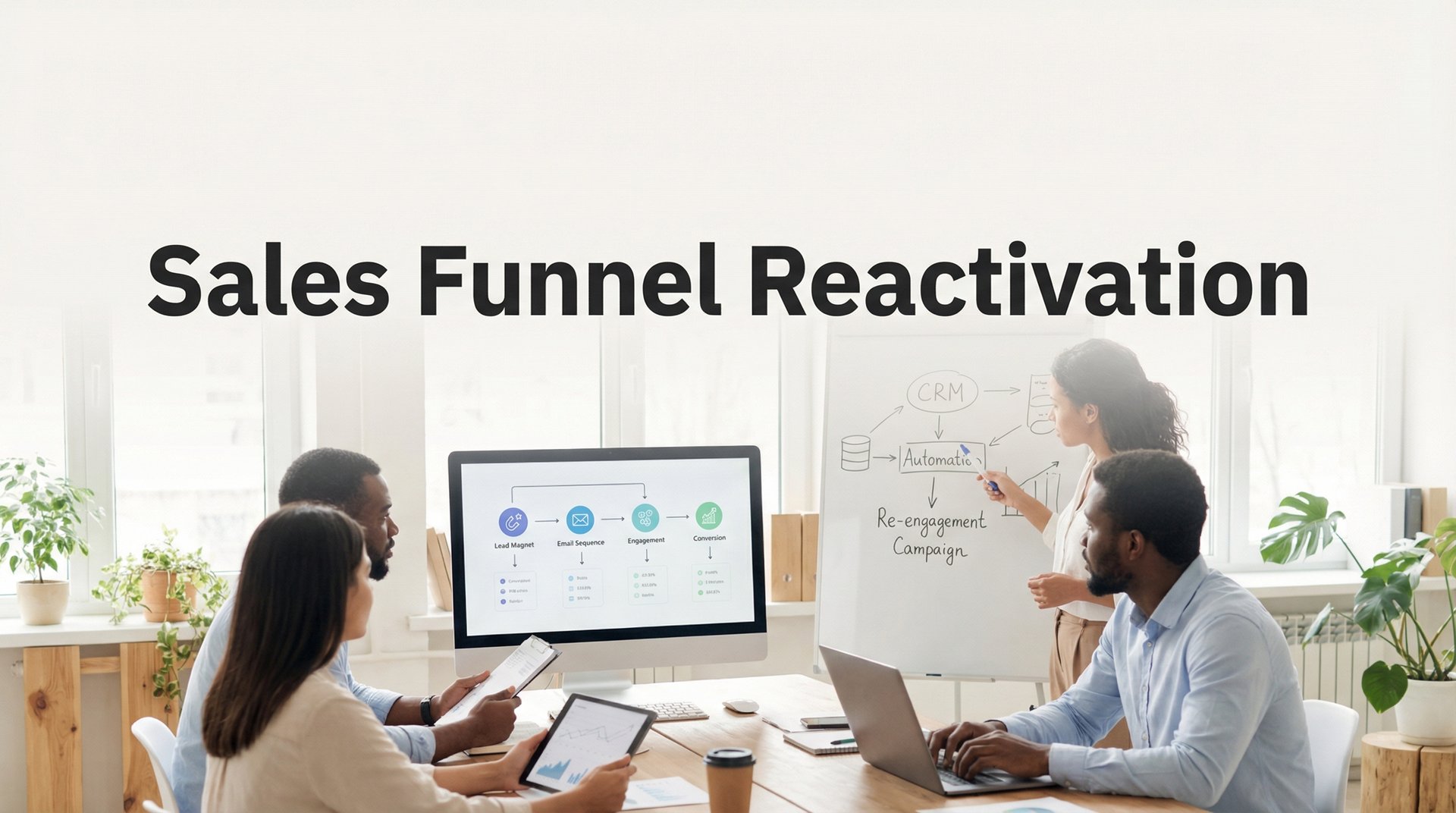

Your CRM is hiding a secret: thousands of dollars in potential revenue that you've already paid to acquire. These aren't cold strangers who need convincing from scratch. They're leads who visited your website, downloaded your guide, requested pricing, or even scheduled a consultation. They expressed genuine interest in what you offer. Then... silence.
Here's the uncomfortable truth most businesses don't want to face: the majority of leads in your database will never convert without strategic intervention. They didn't reject you—they just got distracted, the timing wasn't right, or they fell through the cracks of your follow-up system. While you're spending thousands to acquire new leads through ads and marketing campaigns, these warm prospects are sitting dormant in your CRM, representing revenue you've already invested in but never captured.
This is where sales funnel reactivation changes everything. It's the systematic process of identifying dormant leads, understanding where they stalled in your conversion path, and strategically re-engaging them with the right message at the right time. This isn't about bombarding old contacts with desperate sales pitches. It's about reconnecting with people who already know who you are and what you offer—people who are significantly more likely to convert than someone seeing your brand for the first time.
In this guide, we'll break down exactly what sales funnel reactivation is, why it represents one of the highest-ROI opportunities in your business, and how to implement a reactivation strategy that turns forgotten leads into actual revenue. Whether you're manually managing a small database or sitting on thousands of dormant contacts, you'll learn the framework for bringing these leads back to life.
The Hidden Revenue Sitting in Your CRM Right Now
Sales funnel reactivation is the strategic process of identifying leads who entered your sales funnel but stalled at various stages—and systematically re-engaging them to move them toward conversion. These aren't people who explicitly said "no." They're prospects who showed interest, then went quiet. They're in your database right now, representing investments you've already made in marketing and lead generation.
Think of it like this: you spent money on ads, content, or outreach to get these people into your funnel. They raised their hand and said "I'm interested." Then life happened. Maybe the timing wasn't right. Maybe they got distracted by a competing priority. Maybe they needed more information but didn't know how to ask. Or maybe—and this is the most common scenario—your follow-up system had gaps, and they simply fell through.
The economics of reactivation versus new acquisition tell a compelling story. When you pursue a completely new lead, you're starting from zero awareness. They don't know your brand, don't understand your value proposition, and have no existing relationship with you. You need to build trust, establish credibility, and overcome skepticism—all resource-intensive activities.
Dormant leads, by contrast, already cleared several hurdles. They found you. They engaged with your content or responded to your outreach. They demonstrated some level of interest or intent. Reactivating these leads means you're working with warm contacts who have context about your business. The psychological barriers are lower, the trust foundation exists, and the path to conversion is shorter.
Many businesses report that lead reactivation campaigns generate significantly better ROI than new lead acquisition efforts. The contacts are already in your system, the initial investment has been made, and the incremental cost of re-engagement—especially with modern automation tools—is relatively minimal. You're essentially getting a second chance at revenue you've already paid to pursue.
But here's what makes this opportunity so urgent: your competitors are likely not systematically reactivating their dormant databases either. While everyone fights for the same pool of new leads, the businesses that master reactivation gain access to a revenue source that others completely ignore. It's not about working harder—it's about working smarter with the assets you already have.
Mapping Your Dormant Lead Landscape
Before you can reactivate leads effectively, you need to understand what you're working with. Not all dormant leads are created equal, and treating them as a homogeneous group is a recipe for mediocre results. The first step in sales funnel reactivation is segmenting your database by where leads stalled and how long they've been inactive.
Start by mapping leads to traditional funnel stages. Some leads are at the awareness stage—they downloaded a guide or visited your website but never engaged further. Others reached the consideration stage—they requested pricing, attended a webinar, or had initial conversations with your team. A smaller group made it to the decision stage—they received proposals, discussed implementation, or even scheduled onboarding calls before going silent.
The funnel stage matters because it determines your reactivation approach. An awareness-stage lead needs education and value-building. A decision-stage lead who was days away from signing needs a different conversation—perhaps addressing a specific objection or offering a compelling reason to revisit the decision.
Time since last engagement is your second critical segmentation factor. A lead who went quiet three months ago is in a different psychological place than someone who disengaged two years ago. Recent dormancy might indicate temporary distraction or a short-term barrier. Longer dormancy could mean circumstances have changed, budgets have reset, or competitive solutions have failed to deliver.
Now comes the intelligence layer: identifying reactivation-ready signals within your forgotten leads database. Look for leads who demonstrated high engagement before going quiet. Someone who attended multiple webinars, downloaded several resources, and asked detailed questions showed strong intent—even if they didn't convert. These high-engagement dormant leads are often your best reactivation targets.
Original intent indicators matter too. What brought this lead to you in the first place? Someone searching for a specific solution to an urgent problem has different reactivation potential than someone who casually browsed your site. If you can identify the original pain point or trigger that brought them into your funnel, you have powerful personalization data for your reactivation message.
Purchase timeline alignment is particularly valuable for businesses with predictable buying cycles. If your typical customer researches for three months before buying, a lead who engaged six months ago might now be in a completely different decision-making phase. They've had time to evaluate alternatives, experience pain points, and potentially reach budget approval cycles.
With this segmentation complete, create priority tiers for your reactivation efforts. Tier 1 might be high-engagement leads from the decision stage who went dormant within the last six months. Tier 2 could be consideration-stage leads with strong intent signals from the past year. Tier 3 might be awareness-stage leads or older contacts who require more nurturing.
This prioritization ensures you're focusing energy where it's most likely to generate results. You're not treating every dormant contact the same—you're strategically pursuing the opportunities with the highest conversion potential first, then systematically working through your database based on likelihood of re-engagement.
Building Your Reactivation Sequence Framework
An effective sales funnel reactivation campaign isn't a single email blast hoping for the best. It's a thoughtfully designed sequence that acknowledges the relationship history, provides genuine value, and creates multiple opportunities for re-engagement. The anatomy of this sequence matters as much as the message itself.
Timing is your first strategic decision. Reaching out too soon after a lead goes quiet can feel pushy. Waiting too long means they've completely forgotten about you or moved on to a competitor. The sweet spot varies by industry and sales cycle length, but many businesses find success with an initial reactivation touchpoint around 60-90 days after last engagement, followed by additional touches over the subsequent months.
Channel selection dramatically impacts reactivation success. Email remains a foundational channel—it's non-intrusive, allows for detailed messaging, and provides clear tracking. But email alone often isn't enough. SMS creates urgency and higher open rates, making it valuable for time-sensitive offers or appointment-based businesses. Some reactivation sequences even incorporate direct mail for high-value leads, creating a physical touchpoint that stands out in an increasingly digital world.
The multi-touch approach combines these channels strategically. You might start with a value-focused email, follow up with an SMS reminder about a limited-time offer, and conclude with a final email providing social proof or case studies. Each touchpoint serves a specific purpose in the reactivation journey, and the cumulative effect of multiple channels typically outperforms single-channel campaigns.
Message crafting requires a delicate balance. You're acknowledging a gap in communication without sounding desperate or apologetic. The worst reactivation messages start with "We haven't heard from you in a while..." or "Just checking in..." These phrases scream "generic blast" and provide no reason for the recipient to re-engage.
Instead, lead with value. Share a relevant insight, offer a new resource that addresses their original interest, or highlight a product update that solves a problem they expressed. The message should make the recipient think "This is actually useful" rather than "Oh, another sales email."
Personalization transforms reactivation effectiveness. Reference their original inquiry: "When you downloaded our guide on [topic], you mentioned [specific challenge]..." Acknowledge their previous engagement: "I noticed you attended our webinar on [subject] last quarter..." This demonstrates that you remember them as an individual, not just another email address in your database.
Value-first communication means every touchpoint should provide something useful, even if the lead doesn't immediately convert. Share an industry insight, offer a free consultation, provide a tool or template, or highlight a case study relevant to their situation. You're rebuilding trust and demonstrating expertise, not just asking for a sale.
The reactivation sequence should also create natural off-ramps and escalation paths. Some leads will re-engage immediately—have a clear next step for them. Others need more nurturing—move them into a longer-term sequence. And some will indicate they're not interested—respect that and remove them from reactivation efforts. The framework should be flexible enough to accommodate different response patterns.
AI-Powered Reactivation: Scaling What Works
Manual reactivation works when you're dealing with dozens of leads. But what happens when your dormant database contains hundreds or thousands of contacts? This is where AI-powered sales funnel reactivation transforms from a nice-to-have into a competitive necessity. The technology enables personalization and strategic outreach at a scale that would be impossible with manual effort.
AI-driven reactivation systems analyze your entire dormant database and identify patterns that humans would miss. Which leads engaged with pricing information but never requested a demo? Which contacts opened every email for three months, then suddenly stopped? Which prospects visited your website multiple times in recent weeks despite being dormant in your CRM? These behavioral signals indicate reactivation readiness, and AI can flag them automatically.
Hyper-personalization becomes achievable at scale through AI. Instead of sending the same generic reactivation email to your entire database, AI systems can craft messages tailored to each lead's original interest, engagement history, and current behavior. A lead who originally inquired about a specific product feature receives messaging focused on that capability. Someone who attended a webinar on a particular topic gets content that builds on that knowledge.
The timing optimization capabilities of AI are particularly powerful. Rather than sending reactivation messages at arbitrary intervals, AI can identify optimal engagement windows based on historical data. If leads in your industry typically make purchasing decisions in Q4, the system can prioritize reactivation efforts in Q3. If your data shows that Tuesday mornings generate the highest response rates, messages get scheduled accordingly.
Intelligent AI lead scoring takes the guesswork out of prioritization. AI evaluates multiple factors simultaneously—engagement depth, time since last contact, original intent signals, recent website activity, industry trends—and assigns reactivation scores to every dormant lead. You know exactly which contacts are most likely to convert, allowing you to focus human attention where it matters most while automating outreach to lower-priority segments.
The continuous learning aspect of AI-powered reactivation creates compounding benefits over time. The system analyzes which messages generate responses, which subject lines drive opens, which offers create conversions, and which timing strategies work best. It then applies these learnings to future campaigns, constantly refining the reactivation approach based on real performance data.
Automation doesn't mean impersonal. Modern AI powered sales systems can maintain the authentic, conversational tone that makes reactivation effective while handling the operational complexity of managing thousands of individual outreach sequences. Each lead receives messaging that feels personal and relevant, even though the system is orchestrating hundreds of these conversations simultaneously.
For businesses serious about sales funnel reactivation, AI isn't just about efficiency—it's about unlocking revenue that would otherwise remain inaccessible. The dormant leads in your database represent real money, and AI provides the scalable mechanism to systematically convert those opportunities into actual sales.
Industry Spotlight: Funnel Reactivation for Audiology Practices
Audiology practices face a unique reactivation opportunity that many don't fully capitalize on. The hearing aid sales cycle creates particularly valuable dormant lead pools because of how the decision-making process unfolds. Understanding these dynamics can transform how audiology groups approach their existing patient databases.
Consider the typical patient journey: someone notices hearing difficulties, schedules an evaluation, receives a diagnosis and hearing aid recommendation, then... doesn't purchase. This happens constantly in audiology. The reasons vary—sticker shock, denial about the severity of hearing loss, wanting to "wait and see," or simply needing time to process the information. These patients don't disappear because they're not interested. They disappear because they're not ready yet.
Here's what makes this so valuable: hearing loss is progressive. The patient who wasn't ready for hearing aids eighteen months ago is now experiencing worse hearing difficulties. Their quality of life has declined further. The social isolation has intensified. The frustration with missing conversations has grown. They're significantly more ready to take action now than they were during their initial evaluation.
Sales funnel reactivation for audiology practices means systematically reaching out to these past evaluations with timely, relevant messaging. A hearing check-in campaign might ask "How has your hearing been since your last visit?" This non-pushy approach opens the door for patients to re-engage without feeling pressured. Many will admit that their hearing has worsened, creating a natural opportunity to schedule a follow-up appointment.
Technology upgrade outreach works particularly well for patients who purchased hearing aids years ago but haven't returned for updates. Hearing aid technology advances rapidly, and patients using five-year-old devices are missing significant improvements in sound quality, connectivity, and user experience. A reactivation message highlighting these advances—"The hearing aids you purchased in 2021 have been superseded by technology that offers [specific benefits]"—creates genuine value while driving revenue.
Appointment reminders and follow-up sequences address another common leakage point: patients who scheduled appointments but never showed up, or who completed initial evaluations but never returned for fitting appointments. These are warm leads who took concrete action but didn't complete the journey. A simple reactivation sequence can recover a significant percentage of these lost opportunities.
Life-stage triggers create natural reactivation moments for audiology practices. Retirement often prompts people to finally address hearing issues they've been postponing. Major life events like grandchildren being born create motivation to hear better. Even seasonal factors matter—many people want to address hearing loss before holiday gatherings with family.
Audiology database reactivation helps practices recover revenue from patients who never scheduled follow-ups after initial consultations. These aren't cold leads—they're patients who already visited your practice, met your team, and received professional recommendations. The trust foundation exists. They just need the right prompt at the right time to take the next step.
For audiology groups managing multiple locations and thousands of patient records, automated follow-up for audiologists becomes essential. The practices that implement systematic reactivation strategies consistently report that dormant patient outreach generates some of their highest-ROI marketing activities—because they're reconnecting with people who already know and trust them, rather than spending heavily to acquire completely new patients.
Measuring Reactivation Success: The Metrics That Matter
Sales funnel reactivation isn't a "set it and forget it" strategy. Like any revenue-generating activity, it requires measurement, analysis, and continuous optimization. But which metrics actually matter, and how do you know if your reactivation efforts are working?
Start with your reactivation rate—the percentage of dormant leads who respond to your outreach in any meaningful way. This includes email opens and clicks, SMS responses, website visits, or any action indicating re-engagement. A healthy reactivation rate varies by industry, but many businesses see 15-25% of dormant leads show some level of re-engagement when approached with targeted, value-focused messaging.
The re-engagement to conversion ratio tells you how many reactivated leads actually become customers. Not every lead who opens your reactivation email will buy, but tracking this metric helps you understand the quality of your reactivation efforts. If you're reactivating many leads but few are converting, your targeting or messaging may need refinement. Strong reactivation campaigns often see conversion rates that match or exceed new lead conversion rates.
Revenue recovered per campaign provides the bottom-line view of reactivation ROI. Calculate the total revenue generated from each reactivation sequence, then compare it to the cost of running the campaign. Because reactivation typically involves lower acquisition costs than new lead generation, the ROI often significantly outperforms other marketing channels. This metric justifies continued investment in reactivation strategies.
Time to conversion from reactivation deserves attention too. Some reactivated leads convert quickly—they were ready to buy and just needed a reminder. Others require longer nurturing cycles. Understanding these patterns helps you set appropriate expectations and design sequences that accommodate different decision timelines.
Setting realistic benchmarks matters, especially when you're launching reactivation efforts for the first time. Don't expect every dormant lead to immediately convert. Some leads went dormant for legitimate reasons—they chose a competitor, their circumstances changed, or they're genuinely not in market anymore. A successful reactivation campaign might convert 5-10% of dormant leads, but that represents pure incremental revenue from contacts you'd otherwise never monetize.
Timeline expectations should account for the length of your typical sales cycle. If your product normally requires three months of consideration, reactivated leads will likely follow similar patterns. The difference is that they're starting from a warmer position, potentially shortening the cycle, but immediate conversions shouldn't be the only success metric.
Continuous optimization uses response data to refine every aspect of your reactivation strategy. Which subject lines generate the highest open rates? Which offers drive the most conversions? Which segments respond best to email versus SMS? Which timing intervals produce optimal results? Every campaign generates data that should inform the next iteration.
Segment-level performance analysis reveals which types of dormant leads in CRM are most worth pursuing. You might discover that decision-stage leads from 6-12 months ago convert at 3x the rate of awareness-stage leads from two years ago. This insight allows you to focus resources on the highest-potential segments while deprioritizing lower-performing groups.
The measurement framework should also track negative signals. Monitor unsubscribe rates to ensure your reactivation efforts aren't alienating contacts. Watch for spam complaints or negative responses that indicate you're being too aggressive. The goal is sustainable reactivation that builds relationships, not short-term revenue at the cost of your brand reputation.
Putting It All Together
Sales funnel reactivation isn't about pestering old leads with desperate sales pitches. It's about strategically reconnecting with people who already expressed interest in what you offer—people who are significantly warmer than cold prospects and significantly cheaper to convert than new leads. Every business with a CRM database has this opportunity sitting untapped, representing revenue they've already invested in acquiring but never captured.
The framework is straightforward: segment your dormant database by funnel stage and engagement history, prioritize leads based on conversion potential, craft personalized reactivation sequences that lead with value, and measure results to continuously optimize your approach. Whether you're manually managing a small database or using AI-powered automation to reactivate thousands of leads, the principles remain the same.
For businesses in industries with long sales cycles—like audiology, where patients often need months or years to commit to hearing aids—systematic reactivation becomes even more critical. These aren't leads who rejected you. They're prospects whose timing wasn't right, whose circumstances have likely changed, and who need the right message at the right moment to re-engage.
The competitive advantage goes to businesses that recognize their existing database as a revenue asset, not just a contact list. While your competitors chase the same pool of new leads, you can systematically unlock value from contacts already in your system. The investment has been made. The relationship foundation exists. The only question is whether you'll take action to convert old leads into actual sales.
Every day you delay implementing a reactivation strategy is another day of leaving money on the table. Those dormant leads aren't getting warmer on their own. Without strategic intervention, they'll remain inactive indefinitely—or worse, they'll eventually engage with a competitor who was smart enough to reach out.
Stop Leaving Money on the Table – Revive Your Leads in 7 Days or Less
Your CRM database contains revenue waiting to be unlocked. Whether you have dozens of dormant leads or thousands, systematic reactivation can transform forgotten prospects into active sales opportunities faster than you think. The businesses winning in 2026 aren't just focused on acquiring new leads—they're maximizing the value of every contact they've already invested in capturing. Start with a simple audit: how many leads in your database showed interest but never converted? That number represents your reactivation opportunity, and it's bigger than you realize.
Want More Appointments Without Buying More Leads?
Most businesses are sitting on hundreds or thousands of past inquiries that never converted. We built a simple SMS reactivation system that turns those forgotten leads into real conversations and booked appointments.
See How It Works