
January 15, 2026
7 Best Sales Automation Agency Strategies To Reactivate Dormant Leads
Discover how a sales automation agency transforms forgotten CRM contacts into high-converting revenue opportunities using proven reactivation strategies that cost 5-10x less than acquiring new leads.


Your CRM holds thousands of leads that went cold months ago. Maybe they downloaded a whitepaper, attended a webinar, or requested a demo—then disappeared. While your sales team chases new prospects, these forgotten contacts represent millions in untapped revenue sitting dormant in your database.
The best sales automation agencies don't just focus on net-new lead generation. They understand that reactivating existing database contacts costs 5-10x less than acquiring new leads while often converting at higher rates. These dormant leads already know your brand, showed initial interest, and fit your ideal customer profile. The challenge isn't finding them—it's re-engaging them with the right message at the right time.
Here are ten proven strategies that elite sales automation agencies use to transform client revenue operations, starting with the most overlooked opportunity in your pipeline.
1. Automate Competitor Intelligence and Response Strategies
Sales teams often lose deals to competitors they didn't know were in the running until it's too late. By the time you discover a prospect is evaluating alternatives, they've already formed opinions about your competitors' strengths and your perceived weaknesses. This reactive approach puts you in defensive mode, scrambling to differentiate when the conversation is already framed by competitor messaging.
The most sophisticated sales automation agencies flip this dynamic entirely. They build systems that detect competitive threats early and automatically deploy strategic responses before prospects make comparison decisions. This proactive approach transforms competitive intelligence from a reactive damage-control exercise into a strategic advantage that shapes how prospects evaluate their options.
How Automated Competitor Intelligence Actually Works
Think of automated competitor intelligence as an early warning system combined with a strategic response engine. The system monitors multiple signals that indicate competitive evaluation is happening—prospect visits to competitor websites, engagement with competitor content, LinkedIn connections with competitor employees, or even searches for competitor comparison terms.
When these signals appear, the automation doesn't just alert your team. It immediately initiates carefully crafted response sequences designed to highlight your unique advantages while addressing the specific strengths of the competitor being evaluated. The key is timing—these messages reach prospects while they're actively forming opinions, not after decisions have solidified.
Advanced implementations go beyond simple monitoring. They track competitor pricing changes, product updates, customer review patterns, and market positioning shifts. When significant developments occur—a competitor raises prices, launches a new feature, or receives negative reviews—the system automatically adjusts messaging to capitalize on these changes.
Building Your Competitive Intelligence Framework
Start by identifying your top five to seven competitors and mapping their core value propositions, typical objections they raise about your solution, and the specific advantages they emphasize. This competitive landscape becomes the foundation for your automated response strategies.
Implement tracking that detects when prospects engage with competitor content. This includes website visit tracking (when technically feasible and compliant), monitoring for competitor mentions in email responses, and tracking searches for comparison terms. Many marketing automation platforms can detect when prospects visit competitor domains if they're cookied in your system.
Create response sequences tailored to each major competitor. When a prospect shows interest in Competitor A, they receive content that specifically addresses why companies choose your solution over that alternative. These aren't generic competitive positioning documents—they're targeted narratives that acknowledge the competitor's strengths while clearly articulating your differentiated value.
Develop battle cards and competitive intelligence dashboards that give your sales team real-time visibility into competitive dynamics. When automation detects competitive evaluation, sales reps receive instant notifications with relevant talking points, recent competitive developments, and suggested positioning strategies.
Strategic Response Approaches That Work
Preemptive Value Positioning: Rather than waiting for prospects to ask about competitors, proactively share comparison content that frames the evaluation criteria in your favor. Send educational content about "what to look for when evaluating [solution category]" that subtly emphasizes your strengths.
Competitive Advantage Highlighting: When competitor engagement is detected, automatically send case studies or testimonials from customers who switched from that specific competitor. These real stories carry more weight than feature comparisons because they address actual decision-making experiences.
Objection Prevention: Competitors often raise predictable objections about your solution. Build automated sequences that address these concerns before prospects hear them from competitors. If Competitor X typically claims your solution is too complex, proactively share content about ease of implementation and user-friendly design.
Timing-Based Interventions: Monitor competitor sales cycles and typical evaluation timelines. If prospects engage with competitor content, your automation can estimate where they are in the evaluation process and deliver appropriately timed interventions—early education content versus late-stage differentiation messaging.
Maintaining Competitive Intelligence Currency
2. Build Comprehensive Analytics and Optimization Frameworks
Most CRM databases contain thousands of contacts that all look the same at first glance—a sea of names, email addresses, and basic company information. But hidden within that data are distinct patterns that reveal which dormant leads are worth reactivating and which messaging approaches will resonate with each segment. The difference between a successful database reactivation campaign and one that gets ignored comes down to how intelligently you segment your contacts before you ever send the first message.
Think of your dormant database like a filing cabinet that's been organized by someone who just threw everything into random drawers. You wouldn't send the same message to a Fortune 500 enterprise contact who downloaded your pricing guide six months ago and a small business owner who attended a webinar two years ago. Yet many businesses treat all dormant leads identically, wondering why their reactivation campaigns generate minimal response.
Why Segmentation Transforms Reactivation Results
The most effective sales automation agency partners understand that segmentation isn't just about organizing data—it's about understanding intent, context, and timing. When you segment dormant contacts by original source, you're uncovering how they first discovered you and what problem they were trying to solve. A contact who came through a paid search ad for "enterprise CRM solutions" has fundamentally different needs than someone who found you through a blog post about small business productivity tips.
Industry segmentation reveals the specific challenges and buying cycles your contacts face. A healthcare company operates under different constraints and timelines than a retail business. Company size determines budget authority, decision-making complexity, and the sophistication of solutions they need. A startup with 10 employees requires different messaging than a mid-market company with 500 employees or an enterprise with 5,000.
Engagement level tells you how warm or cold each lead actually is. Someone who opened five emails, attended a webinar, and visited your pricing page multiple times before going dormant is in a completely different category than someone who downloaded one whitepaper and never engaged again. These engagement patterns reveal purchase intent and help you prioritize your database reactivation efforts.
Building Your Segmentation Framework
Start by exporting your dormant contacts (typically those inactive for 90+ days) and creating a segmentation matrix. Your primary dimensions should include:
Original Source Categories: Paid advertising, organic search, content downloads, webinar attendance, referrals, trade shows, or partner channels. Each source indicates different awareness levels and initial intent.
Industry Verticals: Group contacts by the industries they serve or operate within. This allows you to craft messaging that addresses sector-specific challenges and demonstrates relevant expertise.
Company Size Tiers: Segment by employee count or revenue ranges. Small businesses (1-50 employees), mid-market (51-500), and enterprise (500+) require distinctly different approaches and value propositions.
Engagement Scoring: Create a simple scoring system based on past behaviors. High engagement (multiple touchpoints, demo requests, pricing inquiries), medium engagement (several content downloads, email opens), and low engagement (minimal interaction beyond initial conversion).
The magic happens when you combine these dimensions. A high-engagement enterprise healthcare contact who originally came through a webinar requires completely different reactivation messaging than a low-engagement small business retail contact from a paid ad. Your segmentation framework should create 8-12 distinct groups that each receive tailored reactivation sequences.
Turning Segments Into Actionable Campaigns
Once you've segmented your database, develop specific reactivation angles for each group. High-engagement enterprise contacts might respond to messages about new features or case studies from similar companies. Low-engagement small business contacts might need educational content that rebuilds awareness before any sales pitch.
Making the Right Choice
These ten strategies represent the core methodologies that separate exceptional sales automation agencies from basic implementation services. The most impactful starting point? Database reactivation—it delivers immediate ROI by converting leads you've already paid to acquire. Behavioral trigger automation follows closely, ensuring your team reaches prospects at peak interest moments rather than arbitrary intervals. Together, these two strategies create a foundation that typically generates measurable revenue within 30-60 days.
Your selection depends on current pain points. If your CRM is packed with dormant contacts, prioritize database reactivation systems. If timing and relevance plague your outreach, focus on behavioral triggers and predictive scoring. For teams struggling with competitive losses, automated competitor intelligence provides the strategic edge needed to win more deals.
The reality is that most businesses leave significant revenue on the table simply because they lack the systems to capitalize on existing opportunities. Your database contains prospects who already expressed interest, fit your ideal customer profile, and cost you money to acquire. Every day they remain dormant represents lost revenue that compounds over time.
Stop Leaving Money on the Table – Revive Your Leads in 7 Days or Less.Book a demo to discover how database reactivation can transform forgotten leads into your next revenue stream without adding headcount or increasing acquisition costs.
3. HubSpot Sales Hub
Best for: Mid-market to enterprise companies seeking an all-in-one sales automation platform with robust CRM integration
HubSpot Sales Hub has established itself as the comprehensive solution for sales teams looking to automate their entire pipeline without juggling multiple disconnected tools.

What sets HubSpot apart is its native integration between marketing, sales, and service functions—creating a unified customer journey that most agencies struggle to achieve with patchwork solutions. The platform's intuitive interface means your team can actually use the automation features without requiring a dedicated administrator, while the extensive app marketplace provides flexibility for specialized needs.
Where This Tool Shines
HubSpot excels at creating sophisticated automation workflows that feel personal rather than robotic. The visual workflow builder lets agencies design complex sequences with conditional logic, time delays, and multi-channel touchpoints without writing code. The platform's email marketing and notification system ensures sales reps engage prospects at optimal moments—when they're actively reviewing proposals or visiting pricing pages. For agencies managing multiple clients, HubSpot's reporting dashboards provide transparency that builds trust and demonstrates ROI clearly. The sequences feature automates follow-up cadences while maintaining the flexibility for reps to personalize messages based on real-time prospect behavior.
Key Features & Capabilities
- Visual workflow automation builder with drag-and-drop interface for creating multi-step sequences across email, tasks, and internal notifications
- Predictive lead scoring that automatically prioritizes prospects based on engagement patterns, demographic fit, and behavioral signals
- Meeting scheduler with round-robin assignment, buffer times, and automatic calendar syncing across team members
- Email templates and sequences with A/B testing capabilities to optimize messaging performance over time
- Conversation intelligence that records, transcribes, and analyzes sales calls to identify winning talk tracks and coaching opportunities
- Pipeline automation that moves deals through stages based on completed activities, elapsed time, or custom triggers
- Document tracking showing exactly when prospects open proposals and which sections receive the most attention
- Native integrations with 1,400+ tools including Salesforce, Slack, Zoom, and major marketing platforms
Best For / Ideal Users
HubSpot Sales Hub works best for growing companies with 20-500 employees that need a scalable platform capable of supporting both current operations and future expansion. It's particularly valuable for agencies serving clients who want marketing sales alignment, as the unified platform eliminates data silos. Teams that value user adoption over technical complexity will appreciate the intuitive interface that reduces training time.
Pricing
Plans start at $20/user/month for basic features, with Professional tier at $100/user/month including advanced automation and reporting. Enterprise plans begin at $150/user/month. Most agencies find the Professional tier provides the optimal feature-to-cost ratio.
4. Outreach.io
Best for: High-velocity sales teams requiring sophisticated multi-channel sequencing and revenue intelligence
Outreach.io represents the evolution of sales engagement platforms from simple email automation to comprehensive revenue orchestration.

This platform was built specifically for sales teams executing complex, multi-touch campaigns across email, phone, LinkedIn, and SMS. What distinguishes Outreach from competitors is its focus on sales execution methodology—the platform doesn't just automate tasks, it enforces best practices and provides real-time guidance that improves rep performance. For agencies managing enterprise clients with sophisticated sales processes, Outreach delivers the control and visibility executives demand.
Where This Tool Shines
Outreach transforms sales development teams into precision instruments. The platform's sequence intelligence analyzes millions of touchpoints to recommend optimal timing, messaging, and channel selection for each prospect. Agencies can create playbooks that codify winning strategies, ensuring every rep executes with the same effectiveness as top performers. The conversation intelligence feature records and analyzes sales calls, automatically logging key information to the CRM while surfacing coaching opportunities. For agencies focused on pipeline generation, Outreach's A/B testing capabilities let you continuously optimize every element of your outreach—from subject lines to call scripts—based on actual conversion data rather than guesswork.
Key Features & Capabilities
- Multi-channel sequences orchestrating coordinated touchpoints across email, phone, LinkedIn, SMS, and direct mail
- Kaia AI assistant providing real-time battle cards, objection handling, and next-best-action recommendations during live conversations
- Revenue intelligence dashboards tracking pipeline health, forecast accuracy, and deal progression across the entire sales organization
- Automated call recording and transcription with sentiment analysis and keyword tracking for compliance and coaching
- Advanced analytics showing which sequences, messages, and rep behaviors correlate with closed revenue
- Governance controls ensuring brand consistency and compliance across all customer-facing communications
- Native Salesforce integration with bi-directional sync maintaining data integrity across systems
- Customizable playbooks that guide reps through complex sales processes with stage-specific content and actions
Best For / Ideal Users
Outreach is purpose-built for B2B companies with dedicated sales development teams executing high-volume prospecting campaigns. It's ideal for agencies serving clients with average contract values above $10,000 and sales cycles spanning multiple touchpoints. Organizations with 50+ sales reps gain the most value from the platform's enterprise features and analytics capabilities.
Pricing
Pricing is customized based on user count and features, typically starting around $100/user/month for core functionality. Enterprise deployments with full revenue intelligence capabilities generally exceed $150/user/month. Visit site for detailed pricing based on your specific requirements.
5. Apollo.io
Best for: Agencies needing an integrated prospecting database and sales engagement platform in a single solution
Apollo.io solves a problem that plagues most sales automation implementations—the disconnect between prospecting and engagement.
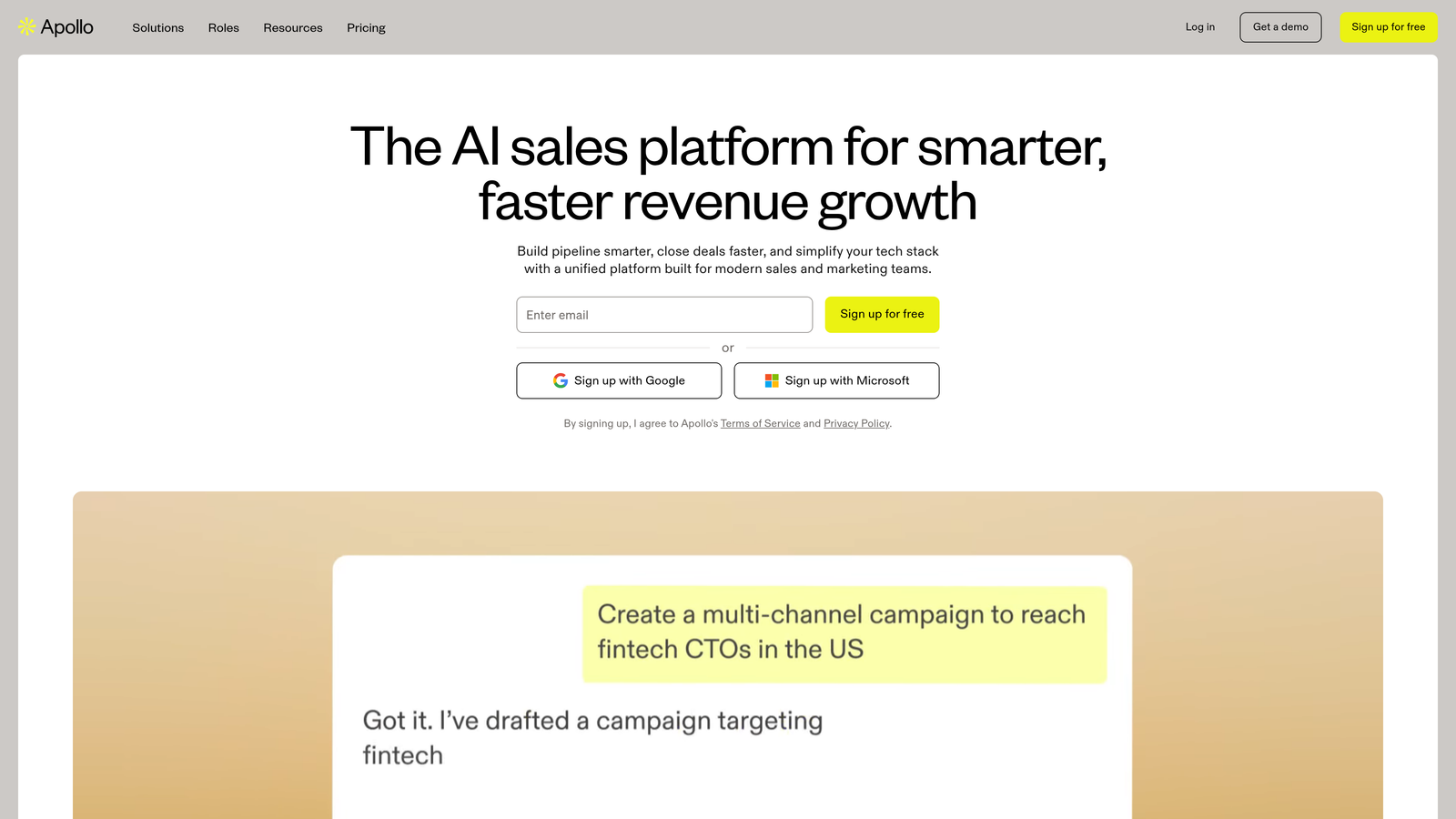
While most platforms require you to source leads elsewhere then import them for outreach, Apollo combines a database of 275+ million contacts with sophisticated engagement tools in one unified platform. This integration eliminates the data transfer friction that typically causes lead leakage and delays. For agencies building outbound programs from scratch, Apollo provides everything needed to identify ideal prospects, enrich their data, and execute multi-touch campaigns without switching between tools.
Where This Tool Shines
Apollo's true power emerges when you leverage its intent data and technographic filters to build hyper-targeted prospect lists. The platform tracks buying signals like job changes, funding announcements, and technology adoptions, allowing agencies to reach prospects at optimal moments. The built-in email verification ensures your campaigns maintain strong deliverability, while the engagement analytics show exactly which messages and sequences drive responses. For agencies managing multiple client campaigns, Apollo's workspace feature provides clean separation between accounts while maintaining centralized billing and administration. The Chrome extension brings Apollo's intelligence directly into LinkedIn and company websites, enabling reps to build lists and launch sequences without leaving their prospecting workflow.
Key Features & Capabilities
- Searchable database of 275+ million contacts with 65+ filters including technographics, funding, employee count, and buying intent signals
- Automated email sequences with personalization tokens, A/B testing, and deliverability optimization
- Built-in email verification and data enrichment ensuring contact accuracy before outreach begins
- Conversation intelligence recording and analyzing sales calls with automatic CRM logging
- LinkedIn automation for connection requests and InMail campaigns integrated with email sequences
- Buying intent data identifying companies actively researching solutions in your category
- Chrome extension enabling prospecting and list building directly from LinkedIn and company websites
- Analytics dashboards tracking email performance, sequence effectiveness, and team productivity metrics
Best For / Ideal Users
Apollo works exceptionally well for agencies building outbound prospecting programs for B2B clients, particularly in technology, professional services, and SaaS sectors. It's ideal for teams that need both lead management and engagement capabilities without managing multiple vendor relationships. Companies with 5-200 employees find the platform scales effectively with their growth.
Pricing
Free plan available with limited credits. Paid plans start at $49/user/month for basic features, with Professional tier at $99/user/month including advanced automation and intent data. Custom enterprise pricing available for larger deployments.
6. Salesloft
Best for: Enterprise sales organizations requiring sophisticated revenue orchestration and sales execution platforms
Salesloft has positioned itself as the revenue orchestration platform for modern sales teams, moving beyond simple automation to provide comprehensive guidance throughout the entire revenue lifecycle.

What makes Salesloft particularly valuable for agencies serving enterprise clients is its focus on sales methodology and execution—the platform doesn't just automate tasks, it ensures reps follow proven processes that drive consistent results. The Rhythm workflow engine orchestrates all revenue-generating activities across prospecting, opportunity management, and customer expansion, creating a unified approach that eliminates the chaos typical of complex sales organizations.
Where This Tool Shines
Salesloft excels at bringing structure to complex sales processes without sacrificing flexibility. The Rhythm engine automatically prioritizes activities based on deal stage, prospect engagement, and historical conversion patterns, ensuring reps focus on the highest-value actions. The conversation intelligence platform, Salesloft Conversations, doesn't just record calls—it provides real-time guidance during conversations and surfaces insights that help managers coach more effectively. For agencies managing enterprise implementations, Salesloft's governance features ensure brand consistency and compliance across thousands of customer interactions. The platform's analytics go beyond vanity metrics to show which activities and behaviors actually correlate with closed revenue, enabling data-driven optimization of sales processes.
Key Features & Capabilities
- Rhythm workflow engine automatically prioritizing and orchestrating sales activities based on deal stage and engagement patterns
- Cadence automation managing multi-channel sequences across email, phone, social, and video touchpoints
- Conversation intelligence with real-time transcription, sentiment analysis, and automated CRM updates from sales calls
- Deal management tools providing visibility into pipeline health and forecasting accuracy across the organization
- Analytics platform connecting sales activities to revenue outcomes with customizable dashboards and reports
- Integration hub connecting to major CRMs, marketing automation platforms, and business intelligence tools
- Coaching workflows that surface opportunities for manager intervention based on rep performance and deal risk
- Messenger enabling asynchronous video messages that humanize digital outreach and increase response rates
Best For / Ideal Users
Salesloft is purpose-built for enterprise B2B organizations with complex sales processes and dedicated sales development, account executive, and customer success teams. It's ideal for agencies serving clients with average contract values exceeding $25,000 and sales cycles involving multiple stakeholders. Organizations with 100+ revenue team members gain maximum value from the platform's orchestration capabilities.
Pricing
Pricing is customized based on user count, features, and implementation requirements. Enterprise deployments typically range from $125-200/user/month depending on modules selected. Contact Salesloft directly for detailed pricing tailored to your specific needs.
7. Instantly.ai
Best for: Agencies and startups requiring unlimited email sending capacity with advanced deliverability management
Instantly.ai has disrupted the sales automation space by solving the deliverability crisis that plagues cold email campaigns.
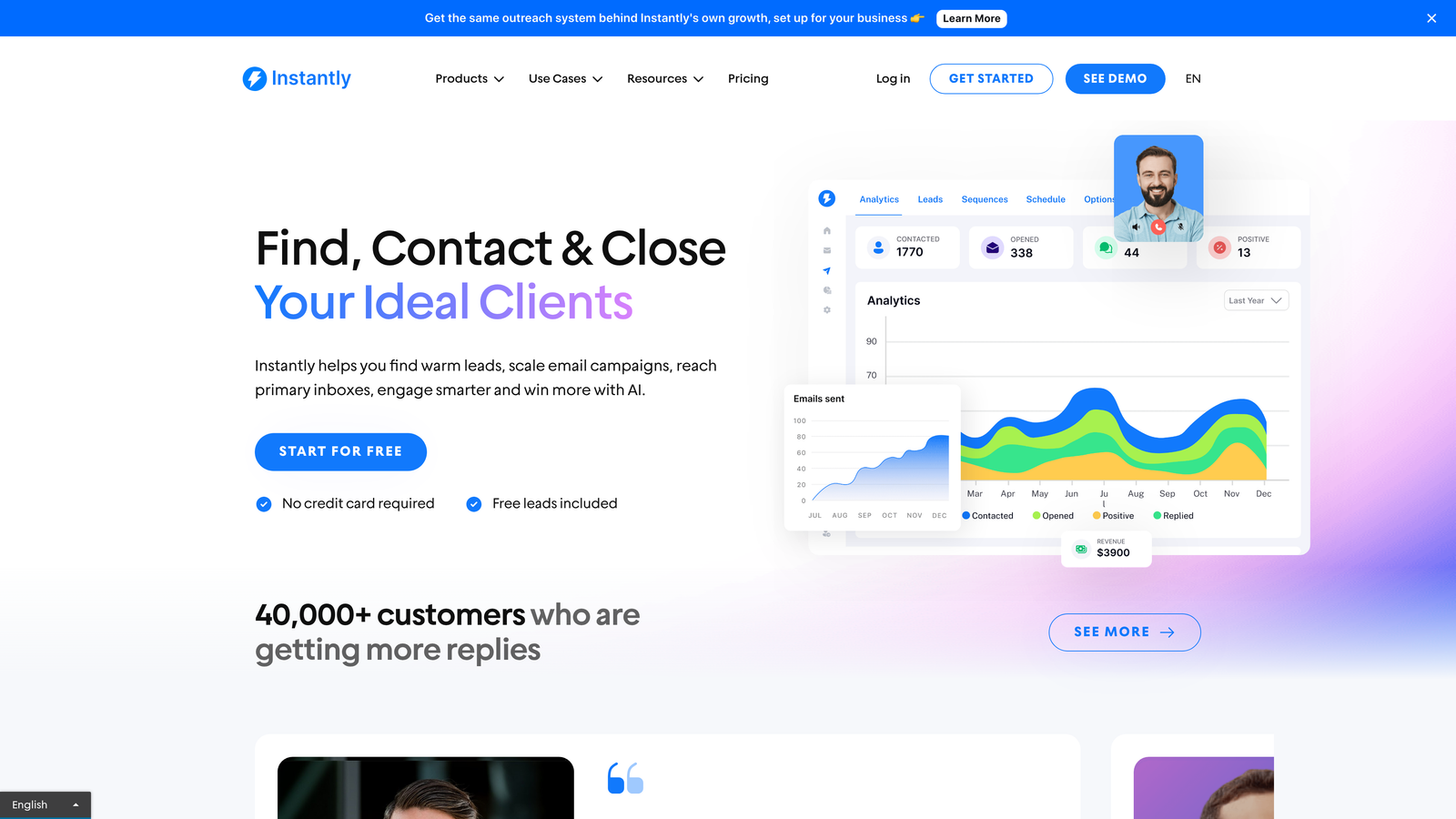
While most platforms limit sending volume or struggle with inbox placement, Instantly provides unlimited email accounts and sophisticated deliverability optimization that keeps messages out of spam folders. This makes it particularly valuable for agencies running high-volume outbound campaigns where traditional platforms would either throttle sending or damage domain reputation. The platform's warmup feature gradually establishes sender reputation for new email accounts, while the unified inbox consolidates responses from dozens of sending addresses into a single interface.
Where This Tool Shines
Instantly's deliverability infrastructure represents its core competitive advantage. The platform automatically rotates sending across multiple email accounts, monitors spam scores in real-time, and adjusts sending patterns to maintain optimal inbox placement. For agencies managing campaigns across multiple clients, the campaign management interface provides clean separation while maintaining centralized reporting and billing. The lead finder database includes 160+ million verified B2B contacts, eliminating the need for separate prospecting tools. What sets Instantly apart is its focus on the technical aspects of cold email that most platforms ignore—SPF/DKIM/DMARC configuration, IP reputation monitoring, and bounce management—ensuring your carefully crafted messages actually reach prospects.
Key Features & Capabilities
- Unlimited email account connections enabling high-volume sending without per-account fees
- Automated email warmup gradually building sender reputation for new accounts before campaign launch
- Advanced deliverability monitoring tracking spam scores, bounce rates, and inbox placement across all sending domains
- Campaign builder with A/B testing, personalization variables, and conditional logic for sophisticated sequences
- Unified inbox consolidating responses from multiple email accounts into single interface for efficient management
- Lead database with 160+ million verified B2B contacts searchable by industry, role, company size, and location
- Campaign analytics showing open rates, reply rates, and conversion metrics across all active sequences
- Team collaboration features enabling multiple users to manage campaigns with role-based permissions
Best For / Ideal Users
Instantly.ai is ideal for agencies and startups running high-volume cold email campaigns where deliverability and sending capacity are critical success factors. It works particularly well for B2B service providers, SaaS companies, and agencies managing outbound programs for multiple clients. Teams sending 10,000+ emails monthly gain the most value from the unlimited sending model.
Pricing
Plans start at $37/month for basic features with unlimited email accounts. Growth plan at $97/month includes lead finder database and advanced analytics. Hypergrowth plan at $358/month adds priority support and enhanced deliverability features. All plans include unlimited email sending capacity.
Want More Appointments Without Buying More Leads?
Most businesses are sitting on hundreds or thousands of past inquiries that never converted. We built a simple SMS reactivation system that turns those forgotten leads into real conversations and booked appointments.
See How It Works